
2026 Luxury Residential Kitchen White Paper: Moving from "Individual Cabinet Procurement" to "Architectural-Level System Integration"
- By Decorvista 01/06 2025
In the multi-million dollar luxury residential and custom villa development sector, an increasingly prominent industry phenomenon is unfolding: when projects lose competitiveness or face delays, it is rarely due to structural issues with the main building. Instead, what causes client hesitation, shrinking profit margins, and derailed schedules typically occurs during the interior fit-out stage—and the kitchen is precisely the “decision-making space” with the highest density of risks and conflicts.
The kitchen is the geometric epicenter where multiple disciplines collide: architectural structure, mechanical, electrical, and plumbing (MEP) systems, stone engineering, architectural millwork, lighting design, smart home automation, and appliance integration. Mismanagement at any single node triggers a domino effect that can jeopardize the entire project.
Consequently, in 2026, a new consensus is shaping the global premium residential market: a kitchen is no longer a simple product procurement item (Product Package), but a complex architectural system engineering project (Architectural System). In the second half of market competition, the game is no longer about who can manufacture cabinets, but who can control and manage the synergistic risks of the entire interior millwork system.
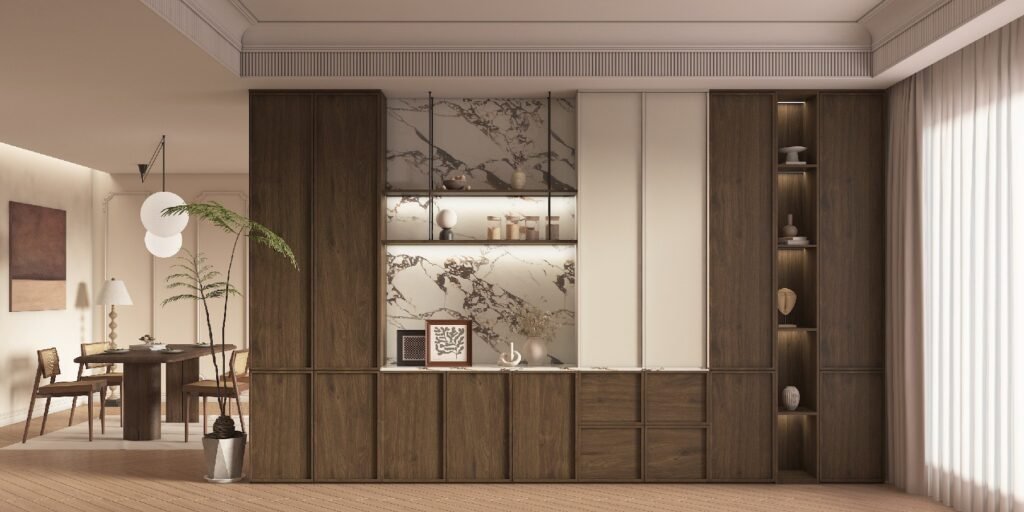
I. The Core Underlying Logic of 2026 Luxury Kitchens: Visual Silence + Engineering Precision
Over the past decade, the luxury housing sector focused on stacking expensive marble, brass hardware, and top-tier luxury appliances. In the coming decade, however, the true sense of premium space will be defined by Visual Silence and Engineering Precision.
High-net-worth clients increasingly refuse to see chaotic outlets, abrupt joints, crude trim lines, exposed mechanical hardware, and material break points in a beautifully designed space. They demand a complete, pure, and continuous architectural environment. The evolution of the following spatial standards is, in essence, a method to exponentially amplify property appraisal value by minimizing visual noise.
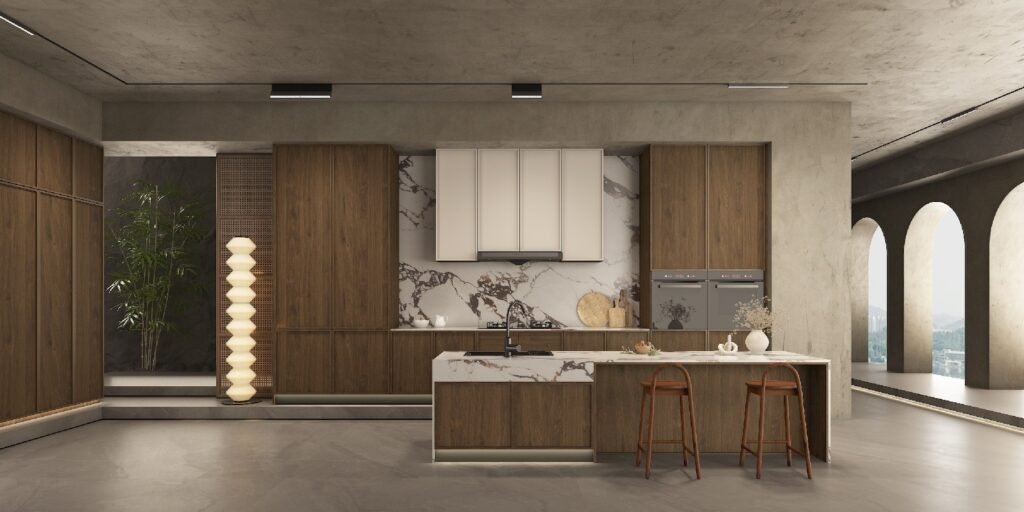
1. Decentralized Tonalities: Two-Tone Aesthetics and the Retreat of Cold Whites
The cold, stark white kitchens that dominated the market for over a decade are rapidly being replaced. In 2026, high-net-worth individuals are fully embracing a return to warm tones and naturalism.
Staining and Natural Light-Wiped Processes: Rift-cut white oak and walnut veneers with fine, straight graining, treated with light-wiped natural stains that preserve the wood’s organic texture, have become standard in modern luxury homes.
Decentralized Visual Hierarchy: Premium design has completely abandoned monochromatic schemes. It favors using the central island as the visual anchor with a completely different wood species or color from the one-sign perimeter base cabinets (e.g., a stone-wrapped island paired with a wood-veneer wall panel cabinet system, or dark base cabinets contrasted with light-colored high cabinets).
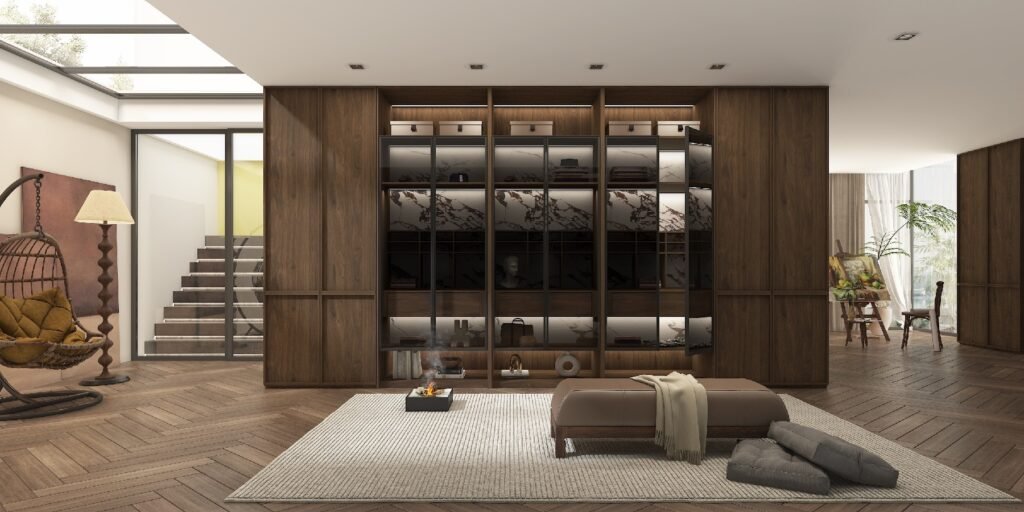
2. Dimension Restructuring: Micro-Adjusting the 3-Inch “Estate Grandeur”
In 2026, architectural-level millwork breaks the boundaries of traditional furniture through precise dimensional restructuring, seamlessly integrating it into the building’s outline.
Upgrading Wall Cabinet Depth from 12″ to 15″ (approx. 38 cm): This 3-inch increase perfectly accommodates oversized western serving trays, large dinner plates, and specialized cookware, boosting internal storage efficiency by over 30%.
Full-Height/Ceiling-Height Cabinetry: Wall cabinets interface seamlessly with the ceiling, eliminating dust-collecting dead zones at the top, elongating vertical architectural lines, and giving the kitchen a gallery-like volumetric presence.
Recessing the Refrigerator Wall by 4–5 Inches (approx. 10–13 cm): Designing a wall recess behind the refrigerator during early construction allows standard large-capacity (25–26 cu. ft.) refrigerators to sit perfectly flush with the cabinetry cabinetry line, achieving a flawless flush built-in/counter-depth integration without the premium price tag of specialized built-in appliances.
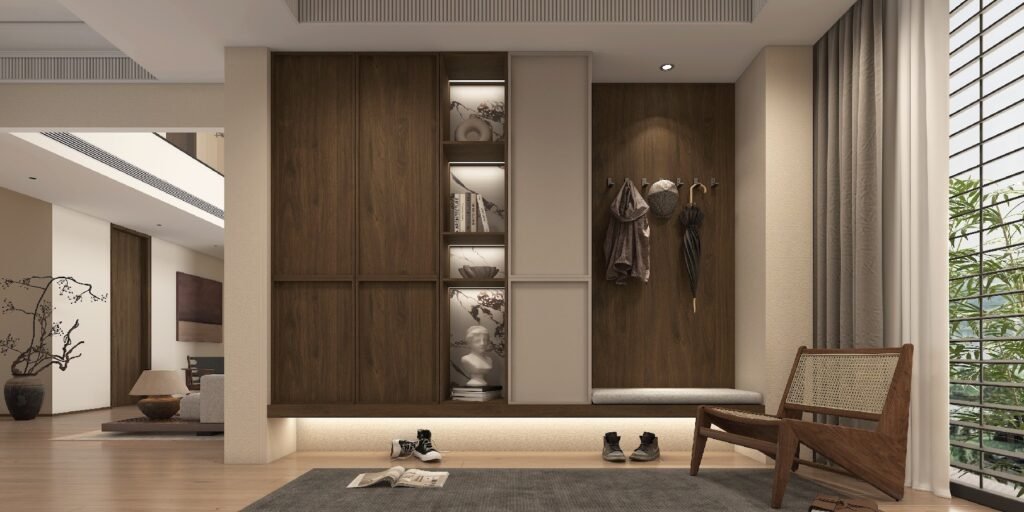
3. Visual Purity: Making Functional Elements “Invisible”
Full-Height Stone Backsplash: Traditional tiled backsplashes are completely obsolete. The natural quartzite, granite, or sintered slab from the countertop wraps uninterrupted up to the bottom of the wall cabinets or the edge of the range hood. Applying penetrating protective sealants at the factory guarantees a 15-year maintenance-free warranty, creating zero visual breakpoints and maximizing the scale of the space.
Hidden Outlet Systems: Punching a series of outlet holes into a premium stone backsplash is the ultimate “culprit” in ruining luxury texture. The new standard installs continuous hidden outlet strips underneath the bottom of the wall cabinets. No visible openings disrupt the stone’s integrity, yet the number of outlets is doubled.
Furniture-Quality Range Hoods: Exposed stainless steel hoods or over-the-range microwaves are fading from luxury residences. They are replaced by custom wood range hoods fabricated by the millwork factory. These integrate high-airflow (CFM) ventilation liners seamlessly with cabinet doors or wall panels, transforming the appliance into an architectural component.
II. Hardware and Concealed Quality: Details Define Longevity
Amateurs judge a kitchen by its doors; professionals judge it by its hardware and edge banding. The tactile feel of opening and closing, combined with durability under extreme microclimates, serves as the true litmus test for foundational quality.
100% Full-Extension Concealed Soft-Close Drawers: Utilizing premium concealed undermount or tandembox runner hardware from brands like Blum, drawers open 100% for effortless access to the deepest corners. Mechanical components remain entirely hidden, preserving clean wood drawer sides for a whisper-quiet, soft-close experience.
Five-Piece Decorative Drawer Fronts: Cheap, flat slab drawer fronts are being phased out. Drawer faces must adopt a five-piece mitered or shaker framing process consistent with the main cabinet doors, ensuring horizontal and vertical linear logic remains perfectly continuous to highlight bespoke craftsmanship.
Large Single-Bowl Apron Front Sinks (Farmhouse Sinks): Apron front/farmhouse sinks with exposed fronts dominate the market, available in stainless steel, porcelain, and highly durable, stain-and-scratch-resistant fireclay. The large single-bowl configuration makes washing oversized cookware and baking sheets effortless.
Coastal-Grade Moisture Resistance: To combat high-humidity coastal environments like Florida, Australia, and New Zealand, production lines utilize PUR automated intelligent edge banding or laser edge banding technology. This achieves molecular-level seamless sealing, fundamentally preventing board warping or delamination caused by moisture.
Integrated Smart Lighting Systems: Lighting is engineered into the skeleton of the millwork from day one. Utilizing layered illumination—under-cabinet task lighting, interior glass-door display lights, and toe-kick/baseboard ambient lighting—many homeowners opt to turn off primary ceiling lights during evening gatherings or movie nights, relying solely on ultra-low energy, heat-free LED linear systems to craft an exclusive, intimate lounge atmosphere.
III. Supply Chain Revolution: Why IDWC is the New Standard for Luxury Housing
The traditional kitchen delivery model is a fragmented, linear chain: Architect ➔ Cabinet Supplier ➔ Stone Fabricator ➔ Electrician ➔ Installer. Each segment operates in isolation. Without centralized coordination, the inevitable results are a disconnect between shop drawings and field conditions, dimensional clashes, blurred liabilities, delayed schedules, and massive rework costs.
A kitchen never exists in isolation. It must maintain absolute cohesion with interior doors, integrated wall panels, custom wardrobes, ceiling details, and flooring materials (such as large-specification 7/8/9-inch wide-plank engineered hardwood or high-wear LVT/luxury vinyl tile). This is exactly why the IDWC (Integrated Doors, Walls, Wardrobes & Cabinetry) system exists.
In 2026, leading luxury residential projects have completely discarded “cabinet-centric thinking” in favor of “system-centric thinking,” adopting an ecosystem model of Design ➔ Shop Drawing Detailing ➔ Intelligent Manufacturing ➔ Integrated Delivery. Before any board is cut in the factory, digital synchronization completes:
Comprehensive Millwork Shop Drawings & Joinery Detailing.
Clash Detection between millwork and MEP (Mechanical, Electrical, Plumbing), ductwork, and smart home automation systems.
A systematic closed-loop ensuring doors, walls, and cabinets share identical materials, graining, color tones, and finishes.
IV. Delivery and Risk-Control Value for Core Stakeholders
For developers and builders, the kitchen is a high-risk area: it typically accounts for over 40% of client design consultation time, over 30% of job site coordination, and over 50% of millwork-related rework. Therefore, an exceptional kitchen solution must possess not only Designability but, more importantly, Constructability—ensuring it can be manufactured, transported, installed, and serviced efficiently within budget and schedule constraints.
The closed-loop values provided to core stakeholder groups include:
1. For Builders & Developers — Mitigating Risk, Maximizing Profits
Minimizing Vendors and On-Site Labor: Transitioning to factory-rigid modular systems that undergo full 3D pre-assembly in the shop simplifies multi-vendor chaos into a single-source solution. Job site coordination costs drop by 40%, schedules are significantly compressed, and on-site finger-pointing or rework is entirely eliminated.
Generating Powerful Property Premium: Compared to standard cabinetry, high-precision IDWC architectural integrated millwork serves as the most compelling highlight in a display home, substantially boosting the property’s Appraisal Value and accelerating capital turnaround.
2. For Architects & Interior Designers — Flawless Execution, Fewer Compromises
Perfect Realization of Design Intent: It seamlessly resolves complex shadowline and cladding reveal details where ceilings, floors, walls, and cabinets meet, carrying the 3D spatial linear logic consistently through the project to maximize final drawing execution rates.
Seamless Digital Integration: Utilizing comprehensive CAD / Revit standard component libraries provided by the factory during early-stage detailing translates design into sub-millimeter (±0.5mm) industrial-grade manufacturing precision (“Design equals manufacturing”).
3. For Self-Build Homeowners — Ultra-Premium Aesthetics, Healthy Legacy
Holistic Family Wellness: Given the massive volume of wood products in whole-house customization, core substrates must strictly comply with NAF (No Added Formaldehyde) or ENF (the world’s highest environmental standard) certifications to guarantee absolute indoor air safety.
Elite Lifestyle Upgrade: Integrating the inevitable shift toward induction cooking (flush, rapid, safe to touch) alongside smart, app-linked built-in double wall ovens and warming drawers—all enveloped in subtle integrated ambient dimming—creates a high-value residential asset built to endure for generations.
The most successful luxury kitchens of the future will never succeed merely because they adopted a trending color or featured an expensive luxury appliance brand. True project value is determined by whether Design, Engineering, and Fabrication achieve seamless synchronization.
A kitchen is no longer just a functional room; it is the ultimate manifesto of an entire residence’s architectural logic, engineering execution, and premium lifestyle expression. Partnering with an IDWC millwork system specialist who truly possesses an architectural integration mindset is the only way to ensure magazine-quality dreams land flawlessly amidst the commercial realities of tight schedules and controlled budgets.